



















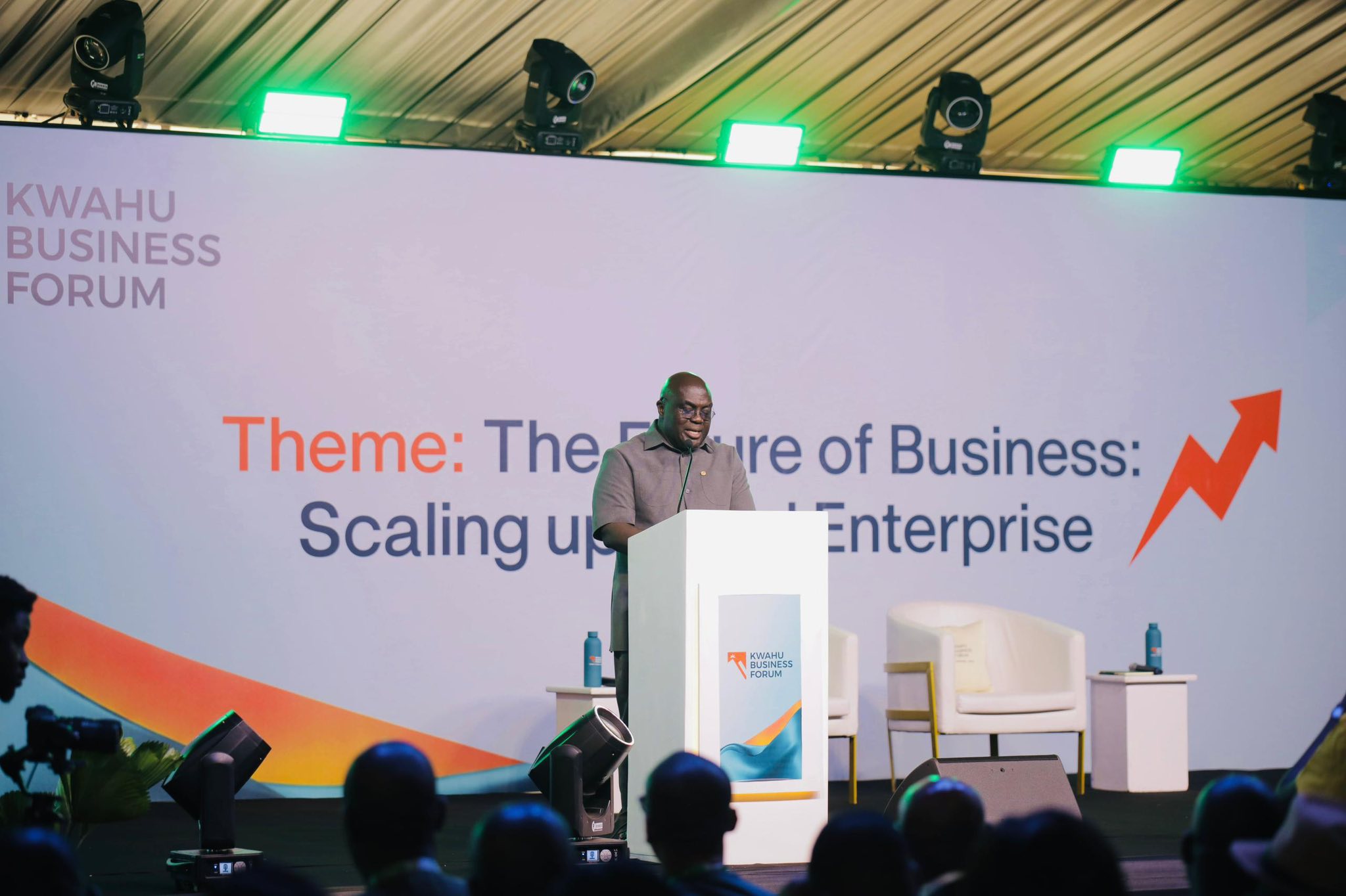
Chief of Staff Julius Debrah has called on government and the private sector to deepen collaboration to accelerate Ghana’s economic transformation.
During his keynote address at the Kwahu Business Forum 2026 on Friday, April 3, Mr. Debrah emphasised that manufacturing must sit at the heart of Ghana’s growth strategy if the country is to achieve a larger, more stable, and more inclusive economy.
“Building a new compact between government and business is a must,” he said, noting that government’s role is to provide an enabling environment, policy clarity, macroeconomic discipline, infrastructure, efficient regulation, skills development, and reliable power.
He stressed that businesses can only thrive when the fundamentals are strong, but also highlighted the responsibilities of the private sector.
“Business must invest boldly, innovate consistently, formalise where necessary, and scale beyond comfort. We must build firms that focus not only on immediate margins, but on long-term competitiveness, resiliency, and national impact,” he said.
Addressing the current global economic climate, Mr. Debrah warned of uncertainty driven by geopolitical conflicts, inflationary pressures, supply chain disruptions, and other external shocks, stating that enterprises must adopt a language of resiliency.
“Firms must be able to withstand shocks, adapt quickly, and remain competitive even in difficult environments. This requires stronger institutions, better planning, local production, deeper supply chains, and a commitment to sustainability and governance,” he explained.
Mentorship emerged as a central theme of his address. He urged established business leaders, industrialists, and financiers to mentor the next generation of entrepreneurs, sharing not only capital, but also experience, wisdom, judgment, and discipline.
“Mentorship is not charity. It is an economic strategy. It is how a country reproduces excellence, strengthens institutions, widens opportunities, and builds a sustainable economy of shared prosperity,” he said.
For younger business leaders, he advised humility, teachability, and a willingness to learn from those with experience.
“Receiving mentorship must be treated not as a favour, but as a duty to learn, grow, and build responsibly. If those who have climbed are willing to extend a hand, those who are rising must also be willing to reach for it,” he emphasised.
In a call to collective action, Mr. Debrah urged Ghana’s business community to convert potential into tangible outcomes.
“This is our time to move from an economy known mainly for commerce into one respected for production, transformation, and competitive strength. Let business lead with courage. Let government support with clarity. Let seasoned leaders raise the next generation, and let our young people see that this country still believes in their future,” he said.
The Chief of Staff said that with discipline, ambition, and unity of purpose, Ghana can build industries, create jobs, expand opportunities, and transform promise into power.
He urged the forum to inspire partnership, enterprise, mentorship, and a new chapter in Ghana’s economic transformation, signalling a renewed commitment to building a resilient and self-reliant economy.
SOURCE: Mubarak Yakubu